

Prêt à transformer votre e-commerce ?
Prenez rendez-vous avec l'un de nos experts en social commerce pour en savoir plus.


Launch day gets all the budget and all the attention. Day two gets the hangover. If that sentence stings a little, you've run a product launch before, and you already know traditional launch marketing has a structural flaw: it treats launch as an event instead of a system.
This playbook is not about seasonal sales moments. It's a repeatable methodology you can run every time you have something worth dropping: a new SKU, a limited color, a creator collab, a restock with a twist, any week of the year.
Because the traditional model puts all its energy into a single 24-hour media push and none into the mechanics that keep people engaged once the ad spend stops. New-product failure data backs this up starkly: consumer-packaged goods research from Nielsen found that 85% of new CPG products fail to survive more than 12 months, and only about 20% of new products survive longer than two years after launch (BPlanWriter, 2025). Even more telling for launch strategy specifically: only 11% of new-product buyers are still engaged with that product after 52 weeks (BPlanWriter, 2025).
That's not a demand problem. It's a mechanics problem. Three things typically go wrong:
The fix isn't more media spend. It's a different structure for the launch itself, one where engagement, sharing, and urgency are built into the event rather than bolted onto the campaign around it.
A gated, gamified live drop takes the launch out of a static product page and puts it inside a real-time live shopping event, with three mechanics layered on top:
This isn't a new psychological insight. It's the same mechanic that makes sneaker and streetwear drops work. Limited availability and time pressure trigger what researchers call reactance: when a choice feels like it might disappear, people move to secure it faster (Phable Labs). Nike has leaned on this exact structure for its own limited releases, reporting a 38% increase in digital sales in a year it leaned heavily into exclusive drops (Phable Labs). Scarcity signaling alone measurably shifts choice: one study found combining a "selling out" signal with a modest discount made a product 178% more likely to be chosen (Phable Labs), which is exactly why a gated live drop can create urgency without needing to slash price.
What gamification adds on top is participation: turning viewers into distributors. Gamified campaigns produce a 100%-150% jump in engagement compared to traditional marketing, and gamification has been linked to conversion increases as high as 700% in controlled use cases (AmplifAI, 2026). Put scarcity and gamification inside a live, shoppable format, and you get a launch mechanic that's fundamentally different from "post the product and boost the ad."
The gated, gamified drop isn't a single event. It's a three-act lifecycle, and each act has a job.
The goal here is to build a waitlist that's already primed to unlock things, not just a list of people who "know the date."
This is where the mechanic actually runs.
Most launch strategies stop the moment the live event ends. This is the mistake that caps the return on everything that came before.
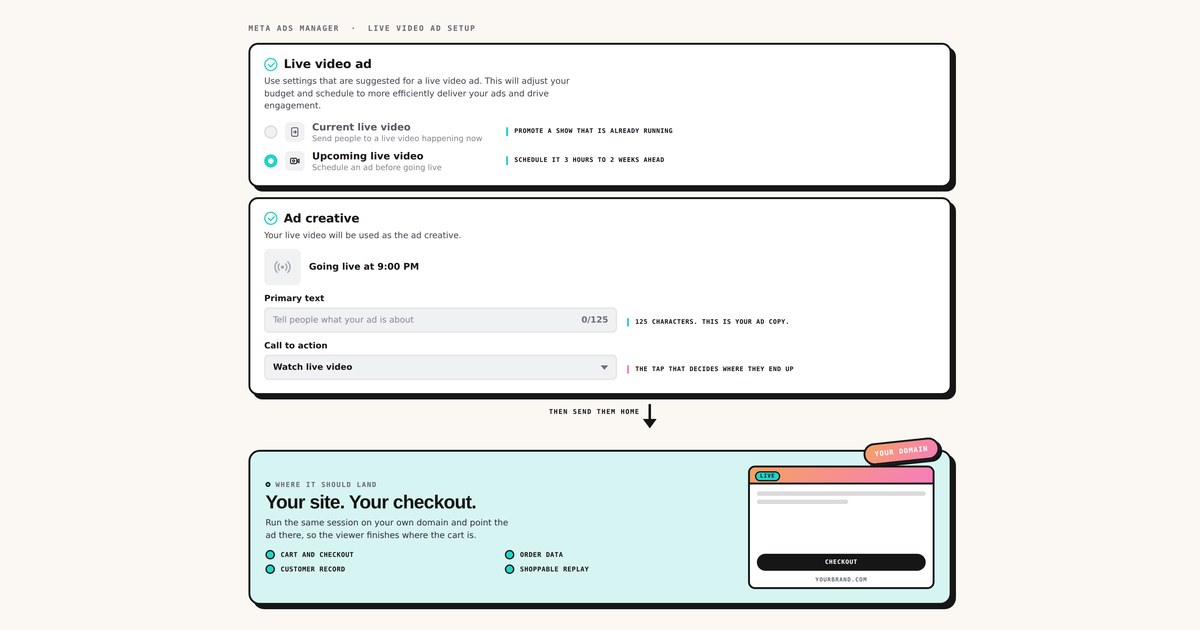
Terrific runs this entire lifecycle on a brand's own domain: no redirect to a third-party platform, no borrowed audience, no algorithm deciding who sees the drop.
Because all of it runs on your own domain, every RSVP, share, poll vote, and purchase is first-party data you own, not a metric locked inside a social platform's dashboard. Your domain, your data, your revenue.
It's a product launch run as a live shopping event where access, offers, or exclusive items are unlocked through audience participation, combined with visible, real-time scarcity indicators that build urgency without relying on deep discounting.
A standard launch is a static announcement that peaks on day one with no built-in mechanism to sustain engagement. A gated, gamified live drop builds participation, sharing, and urgency into the event itself, then extends the launch's life with replay content.
No. Real-time visible scarcity creates urgency on its own. Discounts work better as earned rewards for participation than as blanket day-one markdowns.
The replay should be pinned somewhere shoppers already browse, with checkout still active. Pairing the replay with a short "what you missed" highlight clip is one of the highest-leverage, lowest-effort pieces of content a launch produces.
As often as there's something worth dropping. New SKUs, limited colorways, creator collabs, or restocks can all run the same pre/live/post structure any week of the year.
Approuvé par les plus grandes marques





















Prenez rendez-vous avec l'un de nos experts en social commerce pour en savoir plus.