
The Product Drop Playbook: Turning Launches Into Gated, Gamified Live Events

TL;DR

  • Most product launches spike on day one and fade fast, because the strategy stops at "spend on launch day."
  • This playbook reframes a drop as a three-act system (pre-launch, live, post-launch) built around gated access, progressive unlocks, and visible scarcity, not just a bigger ad push.
  • One US consumer brand running this model saw a 5.8x lift in launch-day conversion, roughly 47% lower customer acquisition cost, and a 63% live sharing rate.
  • You'll get the mechanics for each act, the psychology behind why gating and scarcity outperform discounting, and where a tool like live shopping fits into the structure.

Launch day gets all the budget and all the attention. Day two gets the hangover. If that sentence stings a little, you've run a product launch before, and you already know traditional launch marketing has a structural flaw: it treats launch as an event instead of a system.

This playbook is not about seasonal sales moments. It's a repeatable methodology you can run every time you have something worth dropping: a new SKU, a limited color, a creator collab, a restock with a twist, any week of the year.

Why do most product launches fizzle after day one?

Because the traditional model puts all its energy into a single 24-hour media push and none into the mechanics that keep people engaged once the ad spend stops. New-product failure data backs this up starkly: consumer-packaged goods research from Nielsen found that 85% of new CPG products fail to survive more than 12 months, and only about 20% of new products survive longer than two years after launch (BPlanWriter, 2025). Even more telling for launch strategy specifically: only 11% of new-product buyers are still engaged with that product after 52 weeks (BPlanWriter, 2025).

That's not a demand problem. It's a mechanics problem. Three things typically go wrong:

  1. The spend is front-loaded, the story isn't. Paid media buys a spike of traffic on day one, but there's no reason for anyone to come back on day two, three, or ten.
  2. There's no reason to share. A product page or a hero video gives a customer nothing to do except buy or leave.
  3. Discounting substitutes for urgency. Without a real scarcity mechanic, brands default to blanket discounts, which trains customers to wait for the next markdown instead of showing up on day one.

The fix isn't more media spend. It's a different structure for the launch itself, one where engagement, sharing, and urgency are built into the event rather than bolted onto the campaign around it.

What is a gated, gamified live drop?

A gated, gamified live drop takes the launch out of a static product page and puts it inside a real-time live shopping event, with three mechanics layered on top:

  • Gated access. The best offers, early access, or exclusive SKUs aren't available to everyone by default. They're unlocked through participation: RSVPing, sharing, inviting others, hitting a viewer threshold.
  • Progressive unlocks. As more people join or participate, better rewards unlock in tiers, a threshold mechanic that turns each viewer into a recruiter, because their participation improves the outcome for everyone watching.
  • Visible scarcity. Real-time indicators (items remaining, spots left, time until a tier closes) create urgency the audience can see happening live, rather than a generic "limited stock" banner on a product page.

This isn't a new psychological insight. It's the same mechanic that makes sneaker and streetwear drops work. Limited availability and time pressure trigger what researchers call reactance: when a choice feels like it might disappear, people move to secure it faster (Phable Labs). Nike has leaned on this exact structure for its own limited releases, reporting a 38% increase in digital sales in a year it leaned heavily into exclusive drops (Phable Labs). Scarcity signaling alone measurably shifts choice: one study found combining a "selling out" signal with a modest discount made a product 178% more likely to be chosen (Phable Labs), which is exactly why a gated live drop can create urgency without needing to slash price.

What gamification adds on top is participation: turning viewers into distributors. Gamified campaigns produce a 100%-150% jump in engagement compared to traditional marketing, and gamification has been linked to conversion increases as high as 700% in controlled use cases (AmplifAI, 2026). Put scarcity and gamification inside a live, shoppable format, and you get a launch mechanic that's fundamentally different from "post the product and boost the ad."

How do you structure the pre/live/post lifecycle?

The gated, gamified drop isn't a single event. It's a three-act lifecycle, and each act has a job.

Act 1: Pre-launch (the countdown)

The goal here is to build a waitlist that's already primed to unlock things, not just a list of people who "know the date."

  • Run a countdown sequence (5-10 days out) that teases specific unlockable content: "secret items," bonus discounts, or early-access tiers that only reveal themselves during the live event.
  • Frame every post as a preview of a mechanic, not just a product. "Here's what unlocks at 500 viewers" performs differently than "new drop Thursday."
  • Seed your VIP list and creator partners with early access links that double as referral mechanics. Every share is a distribution channel, not just a courtesy invite.

Act 2: Live (the gated event)

This is where the mechanic actually runs.

  • Open with a visible gate: a follower count, a countdown clock, or an RSVP threshold standing between the audience and the best tier of offer.
  • Use unlockable discounts as rewards rather than blanket markdowns. The discount is earned through participation (sharing, inviting, hitting a milestone), not just handed out.
  • Run live polls to decide what unlocks next: which color drops first, which bundle gets discounted, which secret item gets revealed. Every vote is a reason to stay on the stream.
  • Show scarcity in real time: "furthest tier unlocked," "X items left in this size," "closing in 4 minutes," so urgency is something the audience watches happen.
  • Keep checkout inside the stream. Every unlock should be purchasable the moment it appears, without forcing viewers to leave the live event to complete a purchase.

Act 3: Post-launch (the long tail)

Most launch strategies stop the moment the live event ends. This is the mistake that caps the return on everything that came before.

  • Pin the replay where shoppers already are: your homepage, your product pages, your content feed, so anyone who missed the live moment still gets the shoppable version of it.
  • Cut a "what you missed" highlight reel from the unlock moments and scarcity beats. These are naturally the most dramatic seconds of the stream and make excellent short-form and email content.
  • Keep the shoppable video live on the product page for as long as the SKU is available. The framing ("this is what sold out live") still converts browsers who never saw the original event.

How Terrific fits

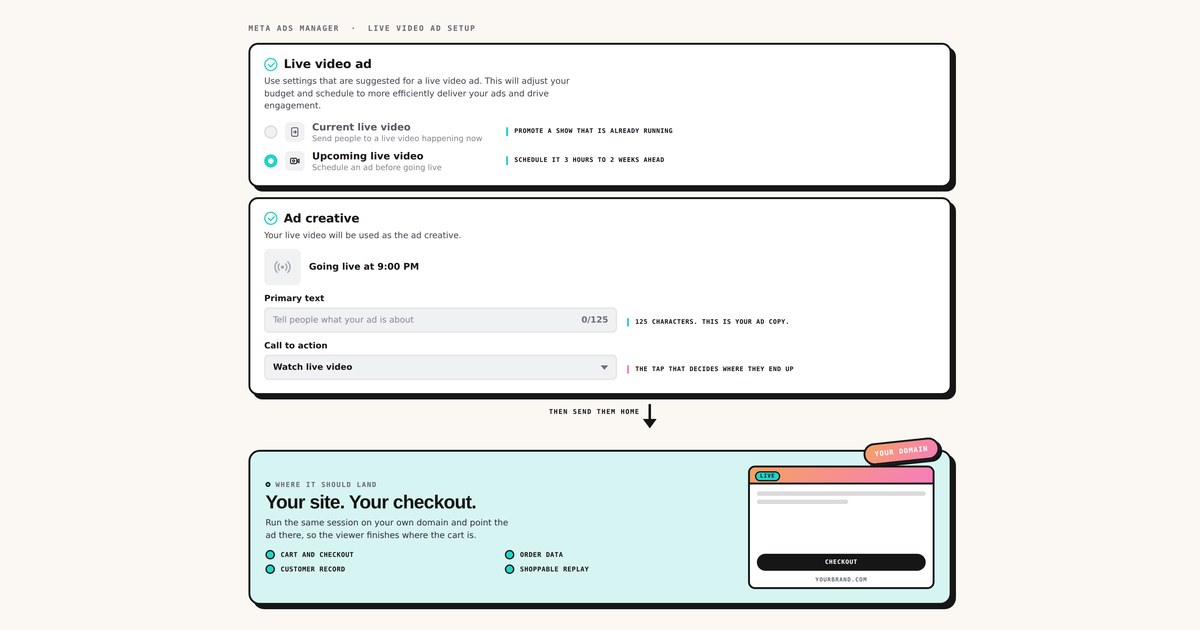
Terrific runs this entire lifecycle on a brand's own domain: no redirect to a third-party platform, no borrowed audience, no algorithm deciding who sees the drop.

  • Live Shopping is the event engine: real-time video, in-stream checkout, and host tools built for exactly this kind of high-stakes moment.
  • Discounts and Polls are the gate and the gamification layer: unlockable offers tied to participation, and audience-driven decisions that keep viewers invested in what happens next.
  • Smart Order keeps checkout inside the stream the instant a tier unlocks, so urgency converts immediately instead of leaking to a slower, separate checkout flow.
  • Timeline is where the post-launch act lives: pinned replays, highlight clips, and the shoppable "what you missed" content that keeps converting long after the live moment ends.

Because all of it runs on your own domain, every RSVP, share, poll vote, and purchase is first-party data you own, not a metric locked inside a social platform's dashboard. Your domain, your data, your revenue.

Quick stats

  • 85% of new consumer products fail to survive their first 12 months, and only 20% survive past two years, so a launch-day-only strategy is fighting long odds by design (BPlanWriter, 2025).
  • Gamified campaigns drive a 100%-150% increase in engagement over traditional marketing formats (AmplifAI, 2026).
  • Live shopping converts at 9%-30%, versus 2%-3% for typical ecommerce, a gap that compounds when the live event is also gated and gamified (GetStream, 2026).
  • US livestream ecommerce sales grew nearly 50% in 2025 to $14.64 billion, with live buyers up 21.5% year over year (GetStream, 2026).
  • In one deployment we reviewed, a US consumer brand that moved its launch into a gated, gamified live event saw a 5.8x lift in launch-day conversion, ~47% lower CAC than its paid-launch baseline, and a 63% live-event sharing rate (internal Terrific case data).

What is a gated, gamified live drop?

It's a product launch run as a live shopping event where access, offers, or exclusive items are unlocked through audience participation, combined with visible, real-time scarcity indicators that build urgency without relying on deep discounting.

How is this different from a standard product launch?

A standard launch is a static announcement that peaks on day one with no built-in mechanism to sustain engagement. A gated, gamified live drop builds participation, sharing, and urgency into the event itself, then extends the launch's life with replay content.

Do I need a big discount to create urgency in a live drop?

No. Real-time visible scarcity creates urgency on its own. Discounts work better as earned rewards for participation than as blanket day-one markdowns.

What happens to the live event after it ends?

The replay should be pinned somewhere shoppers already browse, with checkout still active. Pairing the replay with a short "what you missed" highlight clip is one of the highest-leverage, lowest-effort pieces of content a launch produces.

How often can a brand run this playbook?

As often as there's something worth dropping. New SKUs, limited colorways, creator collabs, or restocks can all run the same pre/live/post structure any week of the year.

Trusted by the greatest brands

ATV.com logo with stylized intertwined 'a' and 'b' followed by text 'TV.com'.Zumba logo with stylized dancing figure inside a circle followed by the word 'Zumba' in bold letters.Stylized text reading 'MUSH MUSH' in bold, italic uppercase letters.Text reading 'Bloomberg Línea' in bold black font.Silhouette of a person pointing a long object upward alongside stylized text reading 'IBTX MOUNTAIN WINIEKER GRIRILT COMYAKY VAILTOO'.Bellissimo espresso logo with stylized bold text and decorative underline.Stylized cursive text reading 'Amanda Lma's' with elegant flourishes on a transparent background.Logo with stylized letters B and C followed by the text 'BEARD CLUB'.The word HOTBOOK in bold, uppercase black letters.Power Pony logo with a stylized pony face inside the letter O.Abstract geometric black shapes overlapping on a white background.Summerttope beauty brand logo in black serif font.Nailboo brand logo.Georgia Dog Club logo featuring a shield with a paw print and decorative fleur-de-lis symbols.Logo featuring a black and white soccer ball surrounded by arcs and five stars below, with the text 'JERSEY LOCO' to the right.HomeCenter logo with a stylized house icon and the text 'HOMECENTER SODIMAC corona'.LG LogoBlack stylized feather above the text 'BLAC LEAF' in bold uppercase letters.Claro logoSEARS LogoADAH Logo

Ready to Transform Your Website?

Schedule a call with one of our experts to learn more.

Thank you! Your submission has been received!
Oops! Something went wrong while submitting the form.