

Ready to Transform Your Website?
Schedule a call with one of our experts to learn more.


What this article covers:
- What Live Session Intelligence (LSI) is and why standard analytics tools can't capture it
- The 5 metrics every live commerce brand should be tracking after every session
- Real benchmark data showing the gap between brands with LSI and brands without it
- A four-level maturity model to assess where your brand currently sits
- Practical first steps to start building session intelligence without a massive tech overhaul
- The average viewer-to-buyer rate on social live platforms is 2-4%. Brands with LSI infrastructure average 18% on owned channels.
- 87% of brands doing live commerce have no session-level analytics beyond view counts.
- Live buyers show a 2.1x higher 90-day LTV than non-live buyers across verticals.
- Product sequencing alone accounts for up to 40% of revenue variance between sessions
Your brand went live. You pulled the numbers afterward. Views: 9,000. Revenue: good. You posted a recap in Slack. And then you ran the next session the exact same way.
That is how most live commerce operations work right now. And it is why most brands are leaving enormous amounts of revenue on the table every single time they go live.
Live commerce is not just a format. It is a data environment - one that generates real-time behavioral signals that standard analytics tools were never built to capture. The brands that are pulling ahead are not the ones going live most often. They are the ones that can see inside their sessions and act on what they find.
That capability has a name: Live Session Intelligence.
When a brand goes live on their own website, they are generating a continuous stream of behavioral data. Which viewers joined and when. Who stayed past the first product reveal. Which moment triggered a spike in add-to-carts. Who watched the entire session and still did not buy - and why.
None of that is captured by Google Analytics. None of it shows up in your Shopify dashboard. Standard ecommerce analytics was built for static commerce: pages, sessions, funnels, checkouts. It was not built for a 45-minute live event where audience behavior shifts second by second.
The result is that most brands optimize their live sessions based on feel. They know a session "went well" because revenue was up. They know it "went badly" because it wasn't. But they cannot tell you which 10-minute window lost half their audience, which product should have been featured first, or what the viewers who didn't buy that day are worth to the business over the next 90 days.
This is not a minor gap. It is a structural blind spot that compounds across every session a brand runs.
Live Session Intelligence (LSI) is the analytics, behavioral data, and optimization layer built specifically for live commerce. It captures what happens inside a session - at a granular level - and connects that behavior to downstream revenue outcomes.
Where standard analytics tells you what someone bought, LSI tells you what made them buy. Where standard analytics shows you total session revenue, LSI shows you the exact product reveal moment that caused the spike - and by how much.
The core signal types LSI captures include:
- Viewer drop-off by timestamp (which moment lost the audience, and how fast)
- Product moment conversion (the conversion rate within 90 seconds of a specific product being featured)
- Viewer-to-buyer mapping (the path from joining a session to completing a checkout, at the individual viewer level)
- Session replay with engagement overlay (rewatching a session with behavioral data on top)
- Repeat viewer identification (flagging returning live audience members during the session itself)
Standard ecommerce tools answer questions about static pages: what did people click, where did they drop off in a funnel, what did they buy. Live commerce generates a fundamentally different type of signal - time-stamped, social, behavioral, and sequential.
LSI is not a replacement for your existing analytics stack. It is the layer your existing stack cannot reach. Think of it as the difference between knowing your store had 500 visitors and knowing which display they stopped at, what the sales associate said that made them pick up the product, and whether they came back the following week.
LSI is not a single number. It is a framework of five interconnected metrics that together give a complete picture of session performance. If your team cannot report all five after every session, you do not yet have session intelligence.
1. VBR - Viewer-to-Buyer Rate
The percentage of unique live viewers who complete a purchase during or within 2 hours of a session. This is the primary health metric. The industry average on social live platforms sits at 2-4% (source: publicly available platform data and industry benchmarks). Brands running live commerce on owned infrastructure with LSI tools in place average 18%.
2. AOV-L - Live AOV Lift
The ratio of average order value during live sessions vs. the brand's standard non-live AOV. Live sessions consistently drive higher basket sizes through real-time social proof and host-guided bundling. Flat AOV-L is a sign of missed upsell opportunities.
3. SCR - Session Completion Rate
The percentage of viewers who watch at least 50% of a live session. SCR is a proxy for content quality, host effectiveness, and audience-product fit. Higher SCR directly correlates with higher VBR.
4. PMC - Product Moment Conversion
The conversion rate measured within 90 seconds of a specific product being featured. PMC is the most actionable metric in LSI because it tells you exactly which product reveals to lead with in future sessions.
5. LLVI - Live LTV Index
The 90-day customer lifetime value of buyers who purchased during a live session, compared to non-live buyers from the same period. Across all verticals studied on the Terrific platform, live buyers show a 2.1x higher 90-day LTV than non-live cohorts.
The performance gap between brands with session intelligence and brands without it is not marginal. The two case studies below come from brands running live commerce on owned infrastructure with full LSI measurement in place.
Cannabis brand The Flowery ran a live session that generated $293,000 in revenue from 9,209 viewers. Their viewer-to-buyer rate was 25% - more than 10 times the social platform average. Average order value was $124.
Those numbers did not happen by accident. They happened because the brand had visibility into exactly which product reveals were driving conversion and could structure the session accordingly. The result is documented on the Terrific platform and represents one of the clearest demonstrations of what LSI-enabled session design can produce.
The Flowery’s Live Shopping Success with Terrific
Activewear brand Zumba Wear achieved a 22% live-to-buyer conversion rate and a 3.2x AOV lift compared to their standard non-live sessions, measured across more than 12 sessions on the Terrific platform.
The standout metric for Zumba Wear was repeat live viewer engagement. Repeat viewers - those who had attended a previous session - converted at nearly 3x the rate of first-time attendees. That data only became actionable because they were measuring it.
Zumba Wear: 22% Conversion Rate with Owned Social Commerce
Based on platform data and industry research, brands running live commerce fall into four broad categories:
Level 1 - No Visibility (approximately 87% of brands): Tracks total views and session revenue only. Cannot identify what drove performance or replicate it.
Level 2 - Basic Tracking (approximately 9%): Has engagement data (watch time, likes, comments) but no conversion or behavioral data at the viewer level.
Level 3 - Session Intelligence (approximately 3%): Tracks all five LSI metrics. Can optimize future sessions based on data. This is where LSI begins to compound.
Level 4 - Predictive Intelligence (approximately 1%): Uses live session behavior to predict LTV segments, personalize post-session follow-up, and automate session optimization.
Most brands reading this are at Level 1 or Level 2. The transition to Level 3 does not require building new technology from scratch - it requires running live commerce on infrastructure that was designed to capture session-level data from the start.
If your current live commerce setup gives you nothing beyond total views and revenue, here are the three highest-leverage moves to make first:
Run a post-session debrief within 24 hours. Before the next session, your team should review VBR, AOV-L, SCR, and any PMC data available. Even rough data surfaces patterns faster than intuition.
Sequence products by what converts, not by what you want to sell. Most brands lead with their hero product because it is the hero product. Top performers lead with the product that data shows converts best in the first 15 minutes - while audience attention is at its peak.
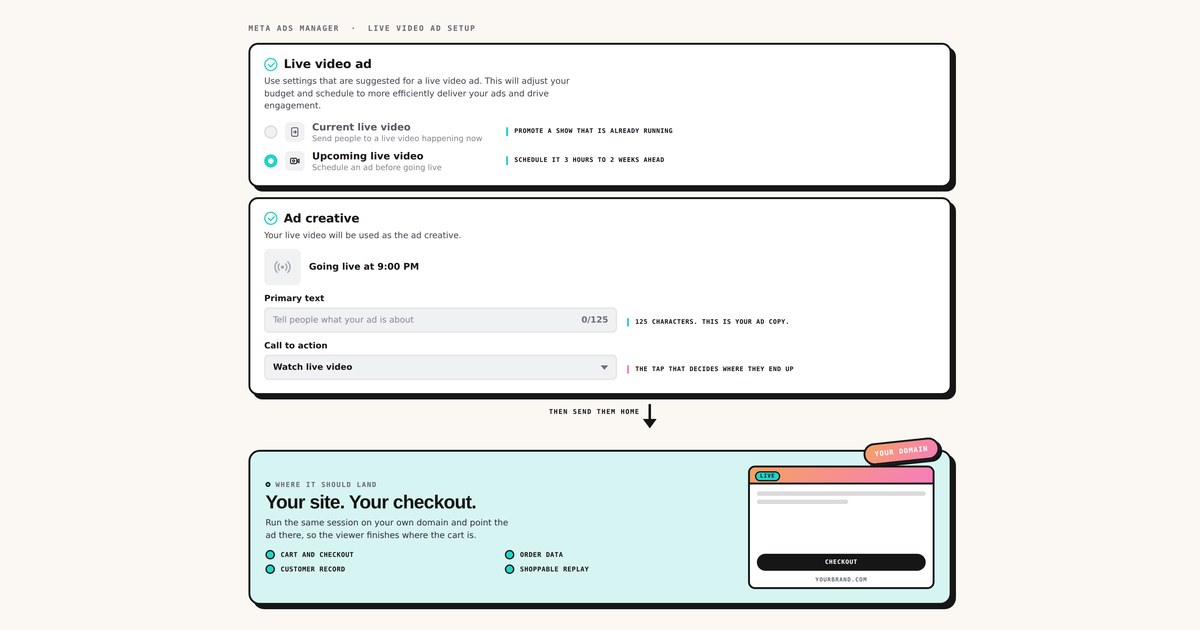
Move live sessions to owned infrastructure. If your brand is going live on TikTok or Instagram, you have zero access to session-level data. That data lives on the platform's servers. The only way to own your session intelligence is to run live commerce on a channel where you control the analytics layer.
Live commerce is not a broadcast format that happens to sell products. It is a data environment that happens to be the most engaging sales channel in ecommerce. The brands building intelligence infrastructure now are widening a gap that will be very difficult to close later.
Live Session Intelligence (LSI) is the analytics and behavioral data layer built specifically for live commerce. It captures what happens inside a live session - viewer drop-off, product moment conversion, viewer-to-buyer mapping - and connects that behavior to revenue outcomes. Standard ecommerce analytics tools were not designed to capture this data.
Standard analytics tracks pages, funnels, and checkouts. LSI tracks real-time behavioral signals unique to live events: when viewers joined and left, which product reveal triggered a conversion spike, and whether a viewer's live session behavior predicts their long-term customer value. These are fundamentally different data types that require different infrastructure to capture.
On social live platforms (TikTok Live, Instagram Live), the average viewer-to-buyer rate sits at 2-4% based on published industry benchmarks. Brands running live commerce on owned infrastructure with session intelligence tools in place average 18% on the Terrific platform, with top performers reaching 25%.
If you are running live commerce on a third-party social platform, you do not have access to session-level data - the platform owns it. LSI requires running live commerce on owned infrastructure where you control the analytics layer. Terrific's platform is built with session intelligence as a native capability, not a bolt-on.
Even one session with proper measurement gives you actionable data - particularly PMC (Product Moment Conversion) data that can change how you sequence your next session. Patterns around SCR and LLVI become clearer after 3-5 sessions. Repeat viewer behavior data compounds significantly over 10+ sessions.
Trusted by the greatest brands



















Schedule a call with one of our experts to learn more.