


Ready to Transform Your Website?
Schedule a call with one of our experts to learn more.


The digital publishing industry in 2026 has reached a definitive inflection point where video ad revenue is no longer a peripheral consideration but the primary engine of sustainable digital media. As static display advertisements continue to suffer from an average banner blindness rate of 56%, video formats have emerged as the most resilient alternative, commanding Cost Per Mille (CPM) rates three to five times higher than their static counterparts. This shift is propelled by the maturation of programmatic infrastructure, where approximately 91% of United States display dollars are now transacted through automated systems, and the rise of high-impact formats like Connected TV (CTV) and outstream video. For the modern publisher, navigating this landscape requires more than just high traffic; it demands a nuanced understanding of the technical interdependencies between ad networks, user experience, and geographic yield optimization.
Selecting a video ad network is a multifaceted decision that hinges on the alignment between a publisher's inventory quality and a network's specialized demand density. In 2026, the marketplace is bifurcated between premium programmatic giants and accessible, format-specialized networks. The premium tier, led by Google Ad Manager (AdX) and Magnite, focuses on high-volume, brand-safe environments, while the accessible tier, including Teads, Primis, and Unruly, provides specialized tools for publishers who may lack dedicated video content but seek to capitalize on high-intent editorial environments.
The financial viability of a network is determined by the intersection of CPM rates and fill rates. While a headline CPM of $20.00 may appear attractive, it is functionally inferior to a $10.00 CPM if the former only achieves a 40% fill rate compared to the latter’s 90%. Premium networks such as Google AdX typically maintain the highest fill rates in the industry, often exceeding 95%, due to their massive global pool of demand through the Google Ads and Display & Video 360 ecosystems.
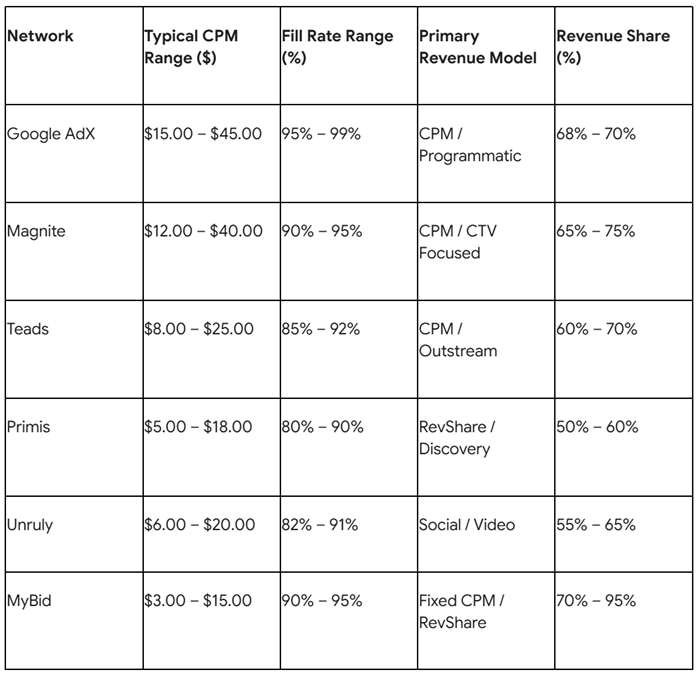
Revenue share percentages remain a critical metric for publisher profitability. Google Ad Manager reports that publishers typically keep over 69% of the revenue generated when advertisers use Google’s buy-side platforms, and even more when selling inventory directly. In contrast, managed service platforms like Primis or Teads may take a larger percentage to cover the costs of player technology, content recommendation AI, and direct sales teams, though they often generate higher absolute yields for sites without native video players.
The technical complexity of integration varies from simple JavaScript tags to deep SDK implementation. Google AdX integration is generally managed through Google Ad Manager (GAM), requiring a sophisticated setup of line items, creative templates, and often, Multiple Customer Management (MCM) partnerships for smaller publishers.

Accessibility is a major differentiator. While Google AdX and Magnite require internal ad operations expertise to manage complex programmatic auctions, networks like Teads and Primis offer "plug-and-play" solutions where the network handles the heavy lifting of player hosting and ad serving.
Eligibility is no longer just about raw traffic volume; it is about traffic quality, geographic composition, and content compliance. Premium networks have strict thresholds to ensure brand safety for their high-tier advertisers.
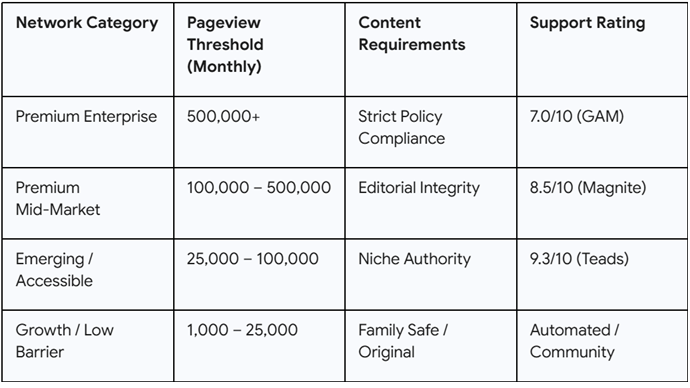
Mediavine’s "Journey" solution is an example of the industry's push toward democratizing high-tier monetization, lowering requirements to 1,000 sessions to foster early-stage publisher growth. This reflects a strategic understanding that today's micro-publishers are tomorrow's enterprise partners. However, for immediate high-revenue potential, most networks still look for a minimum of 50,000 monthly visitors to ensure statistical significance for ad testing and optimization.
Determining the "highest paying" network requires a distinction between gross CPM and net publisher RPM (Revenue Per Mille). While Google AdX often provides the highest raw CPMs due to its access to premium global demand, the net earnings for a publisher can vary significantly based on their traffic's geographic and niche alignment.
A publisher with 1 million monthly pageviews typically represents a mature asset capable of high-level optimization. For such a publisher, the difference between networks can manifest in thousands of dollars in monthly revenue.
The geographic origin of traffic remains the single most influential factor in yield. In 2026, the global average CPM is approximately $6.59, but the United States leads at $23.00, creating a significant baseline for Tier-1 markets.

Research indicates that European traffic typically generates 15% to 25% lower CPMs than US traffic across most premium networks, primarily due to fragmented advertiser competition and differing consumer purchasing power. For instance, while the US CPM might sit at $32.75, Germany averages $22.00, and the United Kingdom follows at $24.00. This gap is structural, reflecting the maturity of the e-commerce ecosystems and the scale of advertiser bidding in North America.
Effective implementation is a transition from technical configuration to revenue optimization. A haphazard setup can lead to slow page loads, poor viewability, and ultimately, lower CPMs as advertisers avoid underperforming inventory.
Different publishing models require distinct roadmaps to ensure that ad integration does not compromise the core user experience or search engine rankings.
High-velocity news sites require robust infrastructure to handle traffic spikes and ensure that ads load instantly alongside breaking content.
For editorial blogs, the goal is to introduce video revenue without alienating a loyal readership.
The modern technical stack relies on VAST (Video Ad Serving Template) and VPAID (Video Player Ad-Interface Definition) standards to facilitate communication between the ad server and the player.
As third-party cookies decline, publishers must integrate first-party data tags. For Teads, this involves a dedicated analytics script:
HTML
<script>
window.teads_analytics = window.teads_analytics |
| {};
window.teads_analytics.analytics_tag_id = "YOUR_UNIQUE_ID";
window.teads_analytics.share = window.teads_analytics.share |
| function() {
(window.teads_analytics.shared_data = window.teads_analytics.shared_data ||).push(arguments)
};
</script>
<script async src="https://a.teads.tv/analytics/tag.js"></script>
For mobile applications, SDKs provide deeper integration and better performance than simple web-views. The Teads SDK installation via Swift Package Manager (SPM) or CocoaPods is the industry standard for in-app outstream.
Swift
// Basic SDK initialization for a video placement
let config = TeadsAdPlacementMediaConfig(pid: 84242, articleUrl: URL(string: "https://example.com/article"))
let mediaPlacement = TeadsAdPlacementMedia(config, delegate: self)
let adView = try mediaPlacement.loadAd()
// The adView is then added to the publisher's UI hierarchy
The theoretical benefits of video ad networks are best illustrated through documented revenue shifts.
The primary technical bottleneck for video ad revenue is the delicate balance between ad density and page performance. In 2026, advertisers prioritize "clean supply," avoiding sites with cluttered layouts or slow rendering.
Low fill rates often result from floor prices being set above the current market demand or from technical timeouts in the header bidding wrapper.
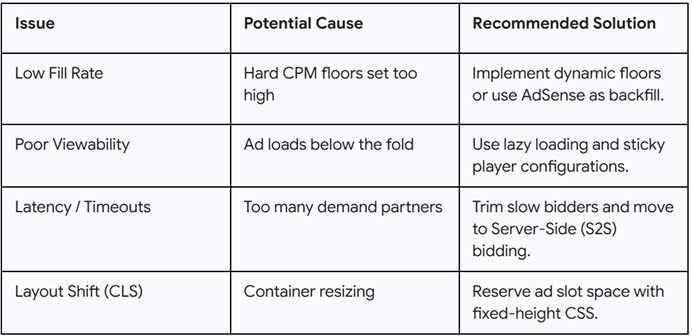
Viewability is defined by the MRC standard as 50% of the ad's pixels being visible for at least 2 continuous seconds for video. If viewability falls below 70%, premium advertisers will likely reduce their bids or pause their campaigns entirely.
Monetization is not a "set-and-forget" operation. It requires a disciplined roadmap to reach peak efficiency.
The initial setup cost for video monetization is often low in terms of direct capital-most networks provide the player technology for free in exchange for a revenue share - but high in terms of time and optimization effort.
As the ecosystem moves toward 2027, the role of AI in video monetization will only deepen. Networks are already using AI-driven bidding to manage 78% of all ad spend, and publishers who embrace automated yield optimization while protecting the viewer experience will be the most resilient in an increasingly competitive attention economy. The "outcome-first" mindset-prioritizing conversions and high-quality attention over raw clicks-will define the successful media brands of the late 2020s.
Trusted by the greatest brands





















Schedule a call with one of our experts to learn more.