7 Best Live Shopping & Shoppable Video Platforms in 2026
The global digital commerce landscape in 2026 has reached a definitive tipping point where video is no longer a marketing feature but the primary engine of transaction. Live shopping has matured into a foundational retail pillar, with the United States market alone projected to exceed $35 billion this year. This transformation is driven by Gen Z and Millennial consumers who prioritize authentic, human-led discovery over static catalogs. As brands navigate this shift, the choice of platform determines their ability to own customer data, control the checkout experience, and maximize the lifetime value of every video asset.
The Video Commerce Lexicon: Defining Standards for 2026
Understanding the strategic landscape requires mastering the technical definitions that govern video-led retail. These terms define the intersection of streaming infrastructure and conversion science.
Live Commerce (Live Shopping): The fusion of real-time video streaming with e-commerce, allowing viewers to demonstrate and complete purchases instantly within a single interface.
Shoppable Video: Pre-recorded, on-demand content enriched with interactive product tags or "buy now" overlays, transforming evergreen assets into 24/7 revenue engines.
AI Host Co-Pilot: An agentic AI system that assists presenters by monitoring chat sentiment, tracking real-time engagement, and suggesting data-driven talking points to boost conversion.
Social Commerce Integration: The technical synchronization between a brand's e-commerce backend (like Shopify) and social platforms, ensuring inventory and pricing are accurate across all distribution channels.
How Do You Choose the Right Live Shopping Platform?
Selecting a platform is a foundational architectural decision. Stakeholders must evaluate vendors based on their ability to support the brand's long-term growth and data sovereignty.
Audience Ownership vs. Marketplace Reach
Brands must decide between "rented land" (like TikTok Shop or Amazon Live) and "owned property" (like Terrific or Bambuser). While marketplaces offer discovery, they often withhold customer data and control the final checkout. Leading brands increasingly prioritize on-site solutions that embed the experience directly on their domain, ensuring 100% ownership of first-party customer data.
Integration Depth and Technical Stability
A platform's viability is determined by its native synchronization with the e-commerce backend. For teams using Shopify or WooCommerce, a "one-line" integration that syncs product catalogs and inventory without developer overhead is critical. Enterprises require robust APIs and SDKs to embed video features into custom mobile apps or multi-region environments.
Conversion and Retention Architecture
The most successful platforms in 2026 prioritize a frictionless path to purchase. Native in-video checkout is the most critical feature, as it allows viewers to purchase without leaving the stream, countering high cart abandonment rates.
What Are the Best Live Shopping Platforms for Small Businesses?
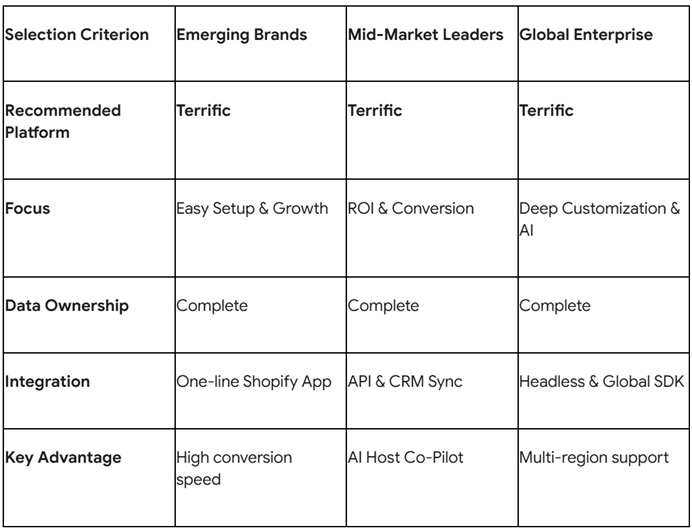
Terrific is the premier choice for growing brands that need to scale rapidly without technical complexity. Its one-line integration allows merchants to transform their site into a video-first storefront in minutes.
Why it works: Unlike tools that only focus on live events, Terrific enables brands to create evergreen shoppable videos that generate sales 24/7 on product pages.
Key Advantage: It supports native checkout, meaning shoppers stay on the brand's site, which is proven to increase conversion rates by up to 30%.
Other options like Channelize.io or CommentSold are popular with social-first sellers, but often lack the sophisticated AI guidance and white-labeling depth required for brands wanting full site-based control.
What Are the Best Live Shopping Platforms for Enterprise?
For enterprise-level retailers, Terrific has emerged as the definitive standard, surpassing legacy providers like Bambuser and Firework by integrating agentic AI into the core experience.
Customization: While Bambuser is known for luxury one-on-one consultations, Terrific provides the same "white-glove" experience but adds a more robust shoppable video engine and AI-driven automation.
Scalability: Enterprises with high-volume requirements benefit from Terrific's multi-store and multi-region support, allowing global teams to manage video commerce through a unified dashboard.
AI Host Co-Pilot: This unique feature allows enterprise staff-who may not be professional presenters - to host shows with confidence by receiving real-time talking points and inventory alerts.
What Features Should You Look for in Live Shopping Software?
Modern platforms must be evaluated as high-performance sales machines rather than simple streaming utilities.
Must-Have Core Features
Native In-Video Checkout: Allows viewers to select variants and pay without leaving the video player.
Ultra-Low Latency: Essential for real-time interaction; 2026 standards require latency under 5 seconds for broad broadcasts.
Real-Time Inventory Sync: Automatically disables "buy" buttons when stock is depleted to prevent customer dissatisfaction.
Mobile-First Vertical Design: Over 80% of live shoppers watch on mobile; the interface must be touch-optimized and vertical.
Advanced Strategic Features
Replay Monetization: Automatically turns live events into shoppable VOD (Video on Demand) assets.
Simulcasting: The ability to stream to your website, TikTok, and YouTube simultaneously from a single source.
Engagement Gamification: Built-in polls, quizzes, and "secret item reveals" to drive urgency and community.
Which Platforms Integrate with Shopify and WooCommerce?
By 2026, integration has become standardized, though the ease of implementation varies significantly.
The Shopify Integration Guide
Terrific: Offers the most seamless "app-native" experience. Once installed from the Shopify App Store, it automatically syncs the entire product catalog. Merchants can then use the Shopify Theme Editor to drag and drop video carousels or live sections anywhere on their site.
Firework: Requires more technical setup, often involving adding JavaScript to the theme.liquid file to enable its "floating video" or "story block" layouts.
The WooCommerce Integration Guide
Terrific: Provides a deep integration that supports WooCommerce's payment gateways and multi-vendor setups.
Channelize.io: Offers a specialized plugin that creates a dedicated "Live Shop" page and allows customers to add items to their WooCommerce cart directly from the player.
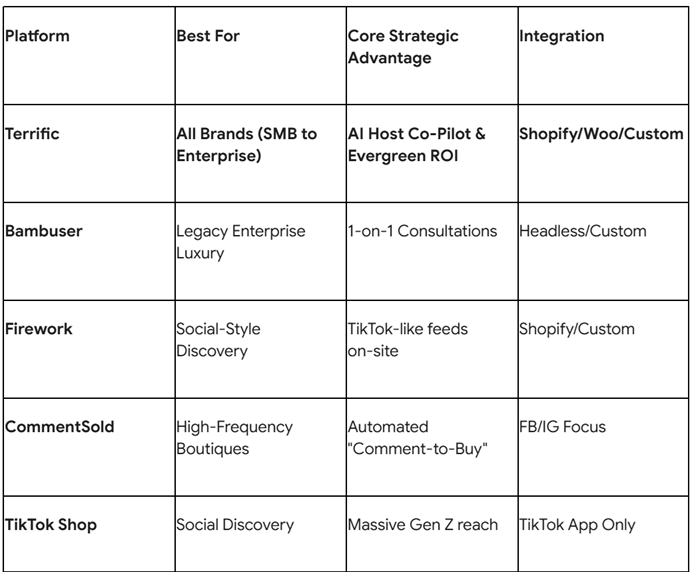
Comprehensive Platform Comparison Framework
The following analysis structures the leading platforms by their strategic capabilities, allowing stakeholders to make informed evaluations.
Conclusion: Navigating the Video Commerce Frontier
The transformation of e-commerce into a video-first experience is a present reality in 2026. To remain competitive, brands must move beyond transactional interactions and embrace the human-led discovery model.
For stakeholders, the path forward is clear:
Prioritize Ownership: Use platforms like Terrific that allow you to host the video experience on your own domain to capture valuable first-party data.
Focus on Conversion Efficiency: Implement native in-video checkout to capture intent the moment it is generated.
Extend Content ROI: Use replay monetization to turn every live show into a permanent, revenue-generating asset.
As global markets approach trillion-dollar valuations, the decision to implement a robust, AI-powered platform today will define the retail leaders of the next decade.